
Consolidated School Consolidated School Teachers Chestnut Flats School Flint Hill School Laurel Springs School Spruce Flats Upper School Lower School

Site Map Cable School Back Schools Page 1
Chestnut Flats Schools
Blount County Court Records November 4, 1837 “ On petition of a number of citizens of Blount County, it is ordered by the Court.....that Joshua Parsons , Robert Shields, Jacob Tipton, William Henry, Joshia Reagan, Russell Gregory, John Frazier, Green Hill, John Davis and James Sparks be appointed a Jury of View, to view and mark a road of second class to the nearest and best way from Emmett’s Mill in Cades Cove to the turnpike road at or near Parson’s and report thereof to any subsequent term of the Court.”
The above order resulted in the Parsons Branch Road from the Cades Cove community to the Parsons Turnpike and stimulated a number of families to establish home places in the area known as Chestnut Flats. Only a few families, including that of Robert Shields , are known to have lived in this isolated area previously. The majority of growth occurred after the Civil War when families, dominated by the Burchfields and the Powells , established a population density with sufficient children to justify a school house.
Flint Hill School
The initial school provided in the Chestnut Flats, reportedly of “slab construction”, was called the Flint Hill School. Individuals have reported discovery of significant flint chips indicating availability of the mineral and a propensity for the Native Americans to fabricate arrow points here. The school was located on the right side of Parsons Branch Road approximately one mile from Forge Creek. A small outbuilding was stocked with blankets and other provisions in case weather “turned bad” and the children could not risk the journey home. Bob Cable’s home was across the road from the school. The Flint Hill School was noted for a fine collection of library books which were lost when the school burned around 1911 with Fred Whitehead as the teacher.
Laurel Springs School
Loss of the Flint Hill School meant a very long walk for Chestnut Flats students to the Lower School, “home schooling” or “no schooling”. The community, responding to the need, quickly constructed the Laurel Springs School, a frame school, in 1911 to provide continuing education in this area. John Burns and Marion Adams were the builders. This school was located approximately ½ mile closer to Forge Creek than the Flint Hill School with land reportedly donated from Post property. The Taylor Whitehead home served as boarding house for several of the teachers. Willie Sparks Burchfield taught in 1919. Her students included McCaulleys , Tiptons , Myers and Cables . Fourteen students were schooled by Elsie Yearout in 1920. $65 per month was the prevailing compensation for Lester Shields in 1924-25 and for Stella McNeilly in 1926-27. The school closed in 1927 due to a low student population in Chestnut Flats and the need for a school house in the vicinity of the Cable Mill.
Spruce Flats School
As true spruce trees grow predominately at elevations above 4000 feet, it is unlikely that the Spruce Flats School, established in the extreme eastern portion of Cades Cove, was accurately named for that species. However, it is known that Appalachian settlers referred to the eastern hemlock as “spruce” which is a more plausible source for the school name.
John “Jackie” Anthony was among the pioneers of Cades Cove with his family establishing a home place at the east end of the Cove on what is now known as Anthony Creek. Other families who were associated with this area included surnames of Rose, Shuler, Shields, Tipton, Cooper, Myers and Ledbetter . These families, and others, created a student population justifying a school house in this area. The one room school was established prior to 1900 about ¼ mile east of the current Cades Cove picnic area and, due to proximity, was also called the Crib Gap School. Although inconclusive, there is some speculation that the “old Rose house” may have been converted into the school. Other memories place the school house just above the Rose house. Autie Sparks taught 21 students here in 1916.
Probably due to a slight shift in student density, the Spruce Flats School was dismantled and relocated to the east end of the current picnic area in 1917. Manuel Ledbetter donated land for this relocation, perhaps influenced to do so by the existence of several “school-age” children. Golden Williams was the teacher in 1921 with 20 pupils and boarded with Little Dan Myers . His daughter, Clemmie Myers , treasured the school bell given as a gift by Ms. Williams. Flora Myers received $60 per month for the 1923-24 term and $65 per month for the 1924-25 term. Other teachers were Louise Trotter , Pearlie Caylor and Nellie Williams .
The Spruce Flats School closed in 1930 due to a much reduced number of students. The few remaining students suffered a lengthy commute to the Consolidated School for their continuing education. “Go west young man!” was an expression which really applied to those youngsters.
Consolidated School
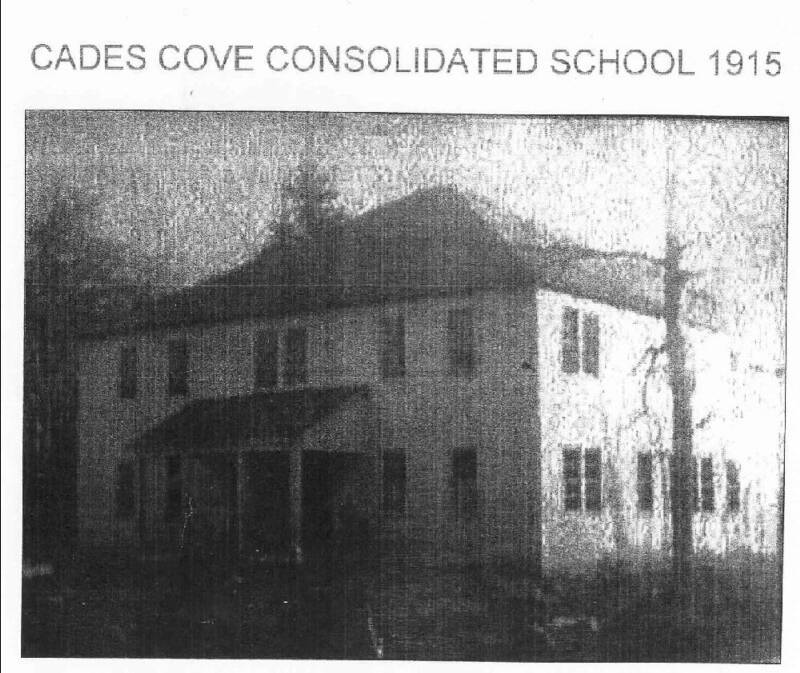
“Consolidation” oftentimes promotes efficiencies and progress. Perhaps these were motivations for combining the Upper School and the Lower School into the Cades Cove Consolidated School in 1915. The site chosen, probably not without a lively community debate, was just east of the Primitive Baptist Church on four acres of property donated by Witt Shields . Always an innovator and progressive community leader, Shields piped water to the Consolidated School from his home and was among those who lobbied unsuccessfully to establish a Cades Cove High School.
The provision of the Consolidated School prompted the Maryville Times to report the school was “ modernly built, modernly lighted and heated, with water from a mountain spring and with educational advantages equal to those of boys and girls in the towns...a splendid example which others would do well to emulate.” The Maryville Enterprise labeled the Cades Cove community as “the most progressive people in the county.”
Envisioned as somewhat of a community center, the frame construction included two floors with the upper level serving as a chapel, assembly area and basketball court. Weather damage from an early summer storm in 1925 resulted in loss of the upper floor resulting in a residual three room, one level school house. Baseball was a popular sport in the Cove. A fine ball field provided recess enjoyment but the other Cove schools were too small for inter-Cove competition. Hoops for basketball were affixed to nearby sturdy oaks. Lunches were eaten outside, weather permitting, where family units would gather around their favorite “eating tree”.
Dedicated teachers administered to the students, traveling to the Cove under rather arduous condition. Angie Caylor Myers recalled that “In 1920, I rode a horse over the old Cades Cove Road, by way of Rich Gap, into Cades Cove to teach my first school.” She also recalls that all of the rooms were not needed for use and that the school term was only five months in length, being completed before Christmas. Some of her students were Amy Burchfield, Flora Gregory, Angeline Brown, Ella Myers, Lucille Oliver , Lester Shields, Kermi t Caughron, Randolph Shields, Wayne Oliver and Labe Gregory . Teachers frequently boarded with Witt Shields and other families.
The Consolidated School was scheduled to operate in 1937 but, after much debate between the community and the Blount County School Board, poor building conditions caused by inadequate maintenance resulted in transfer of the students to the Cable School. The Consolidated School closed after twenty years of Cades Cove community service.
Consolidated School Teachers
1919-20 George H. Myers 1920-21 John E. Shields, Angie Caylor Myers, Mrs. Crockett Emert 1921-23 John Elmer Shields 1923-24 George Myers, Lille Myers 1924-25 George Myers, Kathryn Pryor 1925-26 Jessie Williams, Kathleen Post 1926-27 Lela Clabough, Kathleen Post 1929-30 Grace Lequire, Nina Abbott 1930-31 Grace Lequire, Anne Headrick 1933-35 Ernest Tipton, Nina Abbott 1935-36 Leslie Coulter
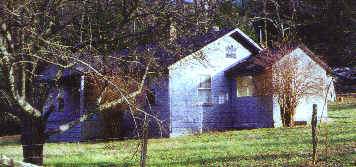
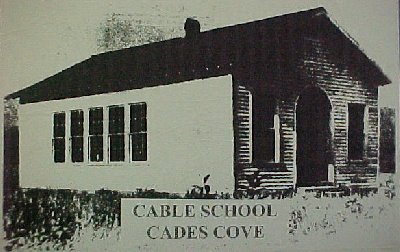
Cable School In 1927, there was need for a school in the southwestern region of Cades Cove. The Blount County School Board recommended a school be established near the Cable Cemetery and in August 1927, the Board specified the school to be identified as the Cable School. One of the more respected Cove matriarchs, Aunt Becky Cable , donated the land for the school. J.C. Post , assisted by Luther Abbott , dismantled the Laurel Springs School and recycled the materials for the Cable School. Even the nails were salvaged! The materials were transported to the school location using Aunt Becky ’s wagon and team of mules. Concrete for the school steps was made using sand removed from Forge Creek. This one room school house educated many students until closure in 1944. Teachers included Raymond Tipton , Eunice Shelly , Flora Shields , Sara Mae Millsaps , Emily Burns , Mildred McTee r, Fred Brewer and Priscilla Martin . A seven month school term was conducted in the 1920s but was extended to eight months throughout the 1930s. Spelling bees, speeches, plays and singings were community events. During World War II, Kermit Caughron and Murray Boring distributed “ration stamps” from the Cable School. Memorial services were conducted there for many Decoration Days at the cemetery. The student population diminished as families moved from the Cove resulting in closure of the Cable School with 14 students in the last class. Rufus Coada was paid $4 per day to bus the remaining students to Townsend. The school building stood another seven years until Kermit Caughron dismantled the structure for his new home. The Laurel Springs School and the Cable School “lived on” as the Caughron residence until it too was dismantled and removed in 2002. It can truly be said that “ Aunt Becky ’s School” had a significant and storied impact on the Cades Cove community. Submitted by D. Post
Kermit salvaged the wood from the Cable School and built this home. It was destroyed in 2002.
Read about it Here
%%%%%%%%%%%%%%%%%%%%%%%%%%%%%%%%%%%%%%%%%
The Upper School
The Upper School was located near Sparks Lane in the vicinity of
Bud Gregory’s
store.
John McCaulley
was among the youth who studied here in 1886.
John L. Law
taught in 1891 for a monthly salary of $22.50 plus $4.00 for room and board. One account establishes 80 students in the eight grades, a very crowded one room school! The term was 4 ½ months.
James R. Oliver
was teaching in 1901 when his father died. He visited a brother in Bryson City, met his future wife and never returned to the Cove. Other teachers at the Upper School included
Marion
and
Martha Brickey
.
Mary Lucinda and Elizabeth Susan Tipton
may have also taught here.
Whether it was politics, roads, religion or just “gals and fellers”, there always seemed to be a good natured rivalry or competition between the folks in the “upper end” of the Cove and those in the “lower end”. Young men gambled on “getting their head knocked off” by rivals’ rocks should they elect to “spark” a young lady from the “opposite end”! The line of demarcation is not specific but was probably along a longitude near the Primitive Baptist Church. It is also uncertain as to which geographical sector was considered superior. The conclusion was probably a function of who was being asked! This competition extended to the Cades Cove school system as schools were established in the 1880s or 1890s which were simply named Upper School and Lower School. Rivalry was spirited in baseball, spelling and debate. Two descendants of the pioneer settler John Oliver played prominent roles in the schools. These were John W. Oliver , son of William H. Olive r, and James R. Oliver , son of William M. “Bill” Oliver . Both commuted to Maryville College in the 1890s and returned to “educate the Cove”. The competition between the two schools ended in 1915 with the creation of the Consolidated School. It could be surmised however that several “school yard wars” occurred to keep the rivalry alive. Subtle distinction between the “upper end” and the “lower end” remained until the end of the active Cades Cove community.
%%%%%%%%%%%%%%%%%%%%%%%%%%%%%%%%%%%%%%%%%
The Lower School The Lower School was established in the vicinity of the Cable Mill and the home of Milburn Cable . This was also a one room school with eight grades. Rev. John McCampbell managed to instruct an unbelievable 120 students in 1896! John W. Oliver taught in 1900 and again in 1903. In 1907, Annie Millsaps enjoyed 60 students. Around 1911, George Roberts taught at the Lower School and boarded with the John McCaulley family on Forge Creek Road for $2 per week. A young Millard McCaulley would “hitch a ride” on the horse Roberts rode to school. William E. Roberts provided instruction for 70 in 1913. After closure of the Lower School, Walter Gregory used a team of horses to relocate the building near the Cable Mill where it was transitioned into the home of Monroe Lequire .
© Page Created by Gloria Motter , All Rights Reserved For The CCPA
© Copyright 1-2005-2007
