If you have CC family history or photos that you want to share, just email it to me
Cades Cove Family Names & History Site Map
CC 1850 Census Tipton Deed for a Church Also See Church Page Witt Shields CCPA LeQuire/Womack Jobes~Olivers~Tiptons Main Genealogy Page Dr. John Calvin Post Russell Gregory~Hill Membership
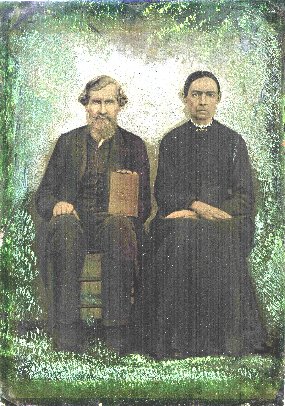
Email Charles Gregory - born May 30, 1823 died May 16, 1900. Celia Carver Gregory born November 30, 1830 died March 20, 1906. Both buried at the Primitive Baptist Church Cemetery, Cades Cove.
I don't have any idea when this picture was done. It is hand-painted on a piece of tin and is very, very dark. Submitted by: Kamy Rayburn Gamble CC Queries
CCPA Exhibit
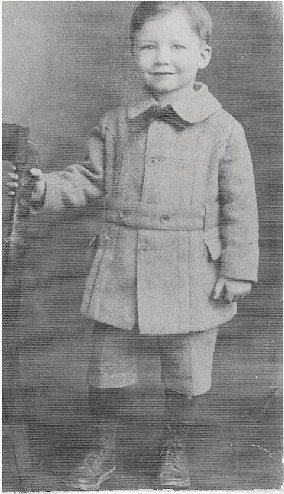
Elmer Paul Tipton
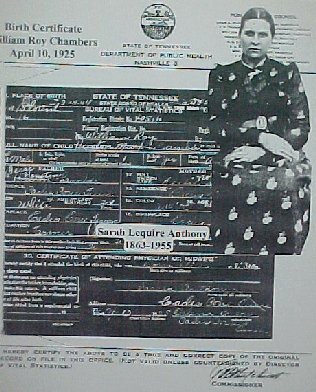
Birth Certificate of William Roy Chambers Photo of Sarah Lequire Anthony 1863-1955 Display at Cades Cove Muesum
Mentioned Midwifes Submitted by D. Post
Polly Harmon was one of the more recognized midwives. She came to the Cove as a licensed midwife and brought many babies into the Cove including the most celebrated historian, Dr. Randolph Shields. Cindy Sparks Cable was also a noted Cove midwife who often traveled through the fields at night, responding with lantern in hand. Other midwives included Sarah Lequire Anthony Frankie Brown Gregory Annie Abbott Bessie Shields Myers Sarah Gregg Wilcox Most womenfolk's would help in emergency situations. Accounts of successful deliveries from the hands of Polly Gregory Shields, Kate Tipton Gregory and even Aunt Becky Cable , who never married, are remembered by Cove descendants.
Elmer Paul Tipton s/o Ollie & Louisa Tipton Submitted by: Linda
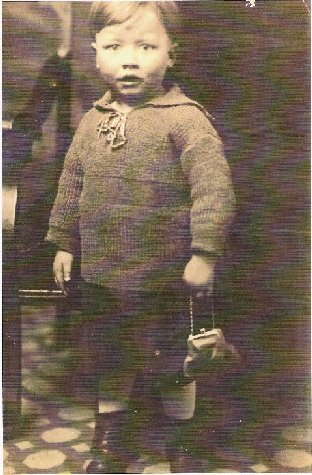
Austin Sparks
Gr Grandson of Leon & Johnnie Bryant Sparks
Andrew Witt Shields Family Affairs 1850-1919 Andrew Witt Shields , known by most as “ Witt ”, was among the second generation descending from Robert and Margaret Emert Shields , a pioneer family of Cades Cove. There would have been a Cades Cove without the Shields , but one can only speculate about the community character without their contributions. Robert Shields moved his family into the Cove in the early 1820s to avoid a typhoid epidemic at Chilhowee. Some feel he initially lived near the current Forge Creek and Parsons Branch Road intersection before moving his family to the headwaters of Forge Creek. Here Shields established one of the earliest Cove tub mills. He later moved into the Cove proper and sponsored early Cove industries of forging and milling in partnership with D.D. Foute and “Fighting Billie” Tipton . He was active in the Baptist Church and in community service as Justice of the Peace and member of the County Court. Witt’s Grandfather apparently was an effective role model as Witt later demonstrated similar values and skills.
Among the children of Robert Shields were Frederick, or “ Fed ”, and William Henry . Each individually had a profound influence on the Cove and “anchored” their future families in Cove lore by marrying daughters of John and Lurany Frazier Oliver , recognized as the first permanent white settlers. Fed appears to have aligned with his father in the southwestern area of the Cove and eventually lived in the largest log house of the community just “down the road” from the first Mill Creek crossing on Forge Creek Road.
Henry elected to live in the northeastern end of the Cove, establishing his home just west of the current picnic area. He and his wife, Martha Oliver , lived reasonably close to the cabin of his wife’s family. Like his father and brother, milling was in his genes! The Henry Shields Mill was established on Anthony Creek. Remnants of the chimney of the “warming shed” can still be observed. Henry and Martha had nine children, including Witt . Witt’s brother, George Washington “Carter” Shields , is remembered by the “ Carter Shields Cabin” exhibit on the south side of the Cove.
Witt Shields married Anna Walker , from Tuckaleechee Cove, in 1878 and established a home place just west of the Carter Shields cabin. They provided eight children to the Cove community, with several marrying familiar surnames including McCaulley , Gregory, Ledbetter , Oliver and Cooper . After the death of Anna , Witt married Mary Lawson , widow of William Lawson , in 1898. His son, George Henry Shields , eventually inherited the Witt Shields home place and raised his family of four children there. Other sons who lived nearby with their families were Tyre Houston Shields and Andrew Witt Shields Jr . Top
Tipton Deed For The Baptist Church
William "Fighting Billie" Tipton was the son of Col. John Tipton of Carter County, both veterans of the Revolutionary War who acquired considerable recognition for their prowess on the battlefield. Col. John Tipton received prominence also for his opposition to John Sevier over establishment of the State of Franklin. William and another son, Thomas , were awarded several Tennessee Land Grants for Cades Cove property as early as 1821 with William being the dominant land speculator. William then enticed several Carter County relatives and neighbors to migrate to Cades Cove with many acquiring property from him. Those early settlers from Carter County included John Oliver , Joshua Jobe , son Jacob and others.
Missy Tipton , among others, documents the properties of William Tipton and the Tiptons of Cades Cove in her recently published book " Precious Memories ". The Cades Cove Baptist Church was formally established by 1827, if my memory is correct, probably first meeting in resident cabins and later building a log meeting house which I'm told was just west of the current Primitive Baptist Church House, probably within the confines of the present cemetery.
Speculation is that William Tipton , who owned the property provided use as a community gratuity. William has not been identified as a Cades Cove resident per se. One Butler Tipton , specific relationship to William Tipton uncertain, is known to have lived in this vicinity. Abraham Jobe , son of Joshua Jobe , references Butler Tipton as one of his school teachers in Cades Cove. In October 1836, William Tipton deeded one half acre of his property to John Oliver and Peter Cable , both former Carter County neighbors, for specific use of the Cades Cove Baptist Church "for the use of public worship forever".
The content of this transaction clearly expresses his admiration of John Oliver and Peter Cable as well as the value he placed on the Cades Cove religious foundation. The transaction also acknowledges the existence of a meeting house already there and the close proximity of Butler Tipton's Former home. The original log meeting house was removed and replaced by the current structure which was built in 1887. More than one earlier structure may have existed. The property provided by William Tipton also became the burial ground for many deceased Cove residents including many pioneer settlers of Cades Cove.
The writing of the Blount County Warranty Deed is difficult to distinguish and legal terminology has changed significantly in the ensuing 150 years or so, compounding the transcription difficulty. Punctuation is also "at the beauty and interpretation" of the reader! Nevertheless, the intent of William Tipton's Deed to the Cades Cove Baptist Church is easily discernible.
Submitted by Dave Post 2-24-05
Also see transcribed deed on the CC Church page
Jobes~Olivers~Tiptons
If you had positioned an ear against the Carter County cabin door around 1818, you might have heard: " Boys, I guarantee you that there's a better place to raise a family just a little southwest of here in a beautiful valley called Cades Cove. Once the settlement is established, life will be easy for you. What a dream you can live!" Admittedly speculative, these could very well have been the encouragements from William "Fighting Billy" Tipton to John Oliver and Joshua Jobe which enticed them to remove from Carter County to the wilderness in Blount County.
The principals involved possessed individually distinguishing attributes, motivations and circumstances which made the proposal attractive. William Tipton inherently was a born fighter, acquiring this trait from his father, John Tipton , heroic in the Revolutionary War and a battler with John Sevier over State politics. Fighting Billy saw speculative land opportunities in the Smoky Mountains and methodically acquired vast property in the Cades Cove area with title to over 1200 acres by 1821. Undoubtedly, the maneuvering for possession initiated several years prior to this time when the land still legally belonged to the Native Americans. Once title was secured, Fighting Billy was obviously motivated to promote settlement as this would increase the value of his investments and enable him to exploit the area's natural resources. If Fighting Billy could provide an opportunity for associates, friends and family in Carter County simultaneously, so much the better. John Oliver and Joshua Jobe were excellent candidates to establish the initial foothold in Cades Cove. John is reported to have been associated with the Tipton ironworks in Carter County as a collier, one who was skilled in the conversion of coal into fuel for the iron furnace.
John came from a respected, but not a wealthy family, and had recently married Lurany Frazier , a bound girl. Both probably wished for a secure life with opportunities so far not afforded them. John's military record and Lurany's maturity were indications that they possessed the courage and inner strength to provide a realistic probability of survival. Joshua Jobe chose Ruth Tipton , niece of Fighting Billy , as his wife, or vice-versa. Joshua was a Deputy Sheriff in Carter County and though slight of stature, backed down to no one. The social relationships between the principals, in terms of timing, nature and frequency is unestablished. It is documented that Joshua directly convinced John and Lurany to make a home in the Cove, perhaps relocating with them, or perhaps assisting their relocation, joining them later. Joshua bought 426 acres from Fighting Billy in late 1821. John was his "next door neighbor" living just to the north on adjoining property. They provided each other with the moral and physical support required to tame the wilderness and "point the way" for many others to follow. Among those who followed were sons of Fighting Billy who initiated a Tipton presence in the Cove community. Fighting Billy later contributed to the Cove survival with forging and milling operations. Joshua Jobe physically left John Oliver after ten years, going to "greener pastures" in Georgia. William Tipton , Joshua Jobe and John Oliver were truly the foundation stones of Cades Cove, encouraging and establishing a thriving community which initially was their dream but eventually became shared with other settlers. Among the three, John uniquely maintained the dream as a lifelong Cove resident. Although removed, Joshua and Fighting Billy lived to see the dream become a reality!
Today, countless Cove descendants and visitors can only attempt to visualize the former community where Joshua Jobe , John Oliver and William Tipton showed the way for many others to establish home places and build families based on faith, love and their shared dream. What a dream it was! Dave Post January 19, 2002 John LeQuire b. abt. 1758-1760 in France, came to Tyson county N.C. ( now Ruterford county) and fought in the Revolutionary War. One of his grandsons Joseph LeQuire & wife Martha Womack , along with two brothers and one sisters came to Cades Cove during the Civil War. Their son Grayson was my grandfather, they are buried at the Cades Cove Methodist Church. Grayson LeQuire married Dan Lawson 's daughter Martha Lawson . Their son Milton Lequire married Ruby Thompson . Notes from Gene LeQuire given to Gloria Motter 2002
Russell Gregory : Cades Cove Pioneer
Perhaps the initial “mountain top herder”, Russell Gregory enjoyed a majestic vigil of Cades Cove from his “summer home” on the grassy bald south of the Cove. His home was located on the North Carolina side of the State Line near the Gant Lot at Rich Gap. This bald became known as Gregory Bald to eulogize the contributions of a pioneer who sacrificed his life for the community. He also maintained a home in the northwestern area of Cades Cove. Russell was born in Georgia in 1795, the son of John Gregory . Family history relates that he met his wife, Susan Hill , in North Carolina while traveling with his father on a trading mission. The “Hill connection” was strong, resulting in a relocation of the Gregorys along with her “kinfolk”, Elizabeth Hill and husband Robert Burchfield , (Susan & Elizabeth's father Green Hill and other relatives to the Cades Cove area in the early 1830s. Russell Gregory is included in the 1840 census as residing west of the Cove proper, perhaps in the Chestnut Flats area. Prior to this time, he preferred a nomadic behavior, moving between North Carolina, Georgia and Tennessee. In 1838, he was established as supervisor for construction of the road, now known as the Parsons Branch Road, connecting Cades Cove with the Parsons Turnpike, to provide access to major markets. In 1853, along with Daniel D. Foute and others, he purchased significant North Carolina property, including the Gregory Bald area. Due to the loss of a hand from infection, Russell was unable to serve militarily in the Civil War. However, using his rifle “Old Long Tom”, he aggressively defended his beloved Cove from renegade forces by organizing a home guard. Frustrated in one foray, the marauders extracted revenge by murdering their nemesis in 1864. The biggest contributions of Russell and Susan Hill Gregory to the community were their eight children who married and populated the Cove with their offspring who provided notable civic and religious services to the community. The Gregory family remained a major influence throughout the history of the Cove. The beautiful flaming azaleas of Gregory Bald are a “fitting memorial” to the man who gave so much. Russell and Susan Hill Gregory are buried in the Primitive Baptist Church Cemetery.
Russell Gregory and Drury Gregory Lease Agreement
In December 1857, Russell Gregory and his first born son Drury , sometimes spelled Druary , or “Drew” Gregory executed a lease agreement for the Gregory farm. This agreement provided lifetime protection for Russell and Susan Hill Gregory , who were then in their early sixties, as well as transfer of the farm to Drury upon death of his parents. The property was located just south of the current Cades Cove Loop Road near the home place and Post Office of Murray Boring and the home place of Golman Myers and others.
Blount County Warranty Deed Book B-B Pages 286-287
Agreement between Russell Gregory & Drury Gregory , both of Cades Cove, Blount County, Tennessee. Witnesseth: The said Russell Gregory leases to Drury Gregory the place on which they now live in Cades Cove, on the following terms and conditions, to wit: Said Russell Gregory reserves to himself & wife a house & home on the place, while they live & Drury Gregory is to manage the farm & pay said Russell Gregory or his widow, if she survives him, the one third of grain raised on the place, delivered at the crib & barn, & the one half of the hay made also. And it is further agreed & understood that at the death of Russell Gregory & his wife, the said Drury Gregory , his heirs or assigns, are to have the said plantation, in fee simple, by paying to John Gregory , Elizabeth Gregory , Charles Gregory , Margaret (Gregory) Burchfield , Catherine (Gregory) Greer & Walter Gregory , children & heirs of the said Russell Gregory , their heirs or assigns, seventy one dollars & forty three cents each, which is to be paid to John Gregory his share one year after the death of said Russell Gregory , & to Elizabeth Gregory two years after, & to Charles Gregory three years, to Margaret Burchfield four years after, to Catherine Greer five years after & to Walter Gregory , six years after the death of said Russell Gregory . It is further agreed & understood that if John Gregory wishes to have one half of the farm & join said Drury Gregory in owning the place, he shall have the right to do so by paying the one half of the aforesaid amounts to the other children as above set forth. It is further agreed & understood that if at any time before the death of said Russell Gregory , either of the parties wish to change the foregoing agreement, they shall have the right to do so on the said Russell Gregory paying to the said Drury Gregory , his heirs or assigns, executors or administrators for any & all permanent improvements he may have made on said place. In testimony whereof we have hereunto set our hands & seals to duplicates this 25th day of December 1857. R. Gregory his DruryXGregory mark
Witnesses present Daniel D. Foute as to Russell Gregory O.B. Foute
W.D. McGinley
as to Drury Gregory
William A. Walker
Note
Russell Gregory
, leader of the Cades Cove Home Guard, was killed during the Civil War at his home in Cades Cove in 1864 by “North Carolina Rebels”. The lease agreement above was registered with the Blount County Register of Deeds on December 31, 1866.
Susan Hill Gregory
survived her husband sixteen years, dying in 1880.
Submitted by Dave Post
Top
Dr. John Calvin Post Cades Cove Entrepreneur Introduction by Cherel Henderson
Cades Cove is one of the most popular tourist spots in the great Smoky Mountains National Park. Visitors drive an eleven-mile loop and see a splendidly beaultiful land of pastures and forests.The lucky ones may spot a deer or come upon a “bear jam” (definition: stand-still traffic caused by sighting of a bear). A few empty houses and cabins, a church, a mill, give testament to the community that once thrived here and remind us the dozens of families who left their mountain homes so that it now belongs to the nation. Dave Post here tells the story of his ancestor, Dr. John Calvin Post , his family, and their life in Cades Cove. The great-great grandson of Dr. John Calvin Post , the author of this article, Dave Pos t, recently sponsored a grave marker dedication ceremony for his ancestor at New Providence Burial Ground, Maryville, Tennessee.
IN MEMORIAM DR. JOHN CALVIN POST MARCH 21, 1803 - January 12, 1873 by David Post On March 21, 1803, in the State of New York, John Calvin Post was born of Jacobus (James) and Rachael Alyea Post . Calvin was the ninth child born to the couple whose ancestors migrated from the Netherlands to the New World in the 17th Century. He was named for John Calvin , leader of the Protestant Reformation in Europe, and adhered to the tenets of Calvinism throughout his life. Although scarce knowledge exists of Calvin’s life in the New England States, Post family lore is that Calvin was educated as both a medical doctor and as a mineralogist or geologist, perhaps in Europe, indicating his immediate family was reasonably wealthy. Calvin became acquainted with many learned individuals and successful businessmen as a result of his academic background and social status(1).
Every indication is that Dr. Post’s passion was aligned with geology and he was specifically attracted to the prospects of discovery of precious metals. He, like many entrepreneurs of his generation, may have been influenced by the perception of vast mineral resources hidden in the lands of the Native Americans who were displaced from the Southeast by treaties in the early 19th Century. Dr. Post integrated his technical abilities, his spirit of adventure and the support of business associates to initiate mineral explorations in the Southeast in the early 1840s. Among his acquaintances was Dr.Gerald Troost , who served as Tennessee State Geologist from 1831 to 1850. As was documented in the Knoxville Register in February 1846, Dr. Post had established a mining partnership with General James Gamble and Thomas H. Calloway in the Pond Creek Community of Roane County prior to 1845. While residing in Roane County, Dr. Post became acquainted with Dr. Isaac Anderson , leading Presbyterian Evangelist and Founder of Maryville College, who had established an early church in Kingston and shared Dr. Post’s interests in the exploitation of mineral resources. Based on family history, Dr. Post occasionally journeyed back to New England to attend to family affairs. When returning to Roane County via steamboat on one such visit, a boiler explosion resulted in major injuries to Dr. Post which impaired his physical abilities for life.Tragically, a brother who was accompanying him lost his life in the accident. Another brother, William, also began the journey but disembarked earlier in Illinois escaping injury. Undoubtedly relying on his friend and spiritual advisor, Dr. Anderson , Dr. Post was directed to the home of William Thompson , near Maryville College, to recover from his injuries. At this time, Mr. Thompson was mourning the death of his wife, Rebecca Wallace , the granddaughter of William Wallace and daughter of Jesse Wallace, both Revolutionary War soldiers. William Wallace was among the founding fathers of Blount County(2). There at the Thompson home, now preserved as the Thompson-Brown House, Dr. Post was introduced to Martha, William’s daughter who was twenty years younger than he. Romance blossomed resulting in their marriage in 1846 with Dr. Anderson officiating.
During his recovery, Dr. Post elected to abandon his interests in the Pond Creek mine, becoming attracted to mineral resources in the Smoky Mountains where Dr. Anderson and his relatives in the McCampbell family were directed. In partnership with the McCampbells, Dr. Post initiated development of the Eldorado Mines on Rich Mountain near the headwaters of Hesse Creek in 1846(3). He established a cabin home for Martha in this vicinity, obviously a much more austere environment than that which she enjoyed in Maryville. Remnants of chimney rocks, an ore smelter and several mine shafts are testaments to that venture. In 1847, the Post’s first child, John Calvin Post II, or Junior, was born at Eldorado.
Apparently disappointed in his results at Eldorado, but remaining optimistic, Dr. Post relocated his family to the Southwestern region of the Cades Cove pioneer community in 1847, still following the same mineral vein which initially attracted him to the Smokies. There, near the intersection of the Parsons Branch and Forge Creek Roads, Dr. Post established his cabin home place known as Laurel Springs. Dr. Post’s holdings there, totaling 10,000 acres, were acquired from Thomas H. Calloway , partner in the Pond Creek mine and administrator of the estate of his father, Joseph Calloway, surveyor of the Hiwassee District. Dr. Post is said to have developed extensive gardens, orchards and vineyards, corresponding with leading nurserymen in the optimization of his efforts. The East Tennessean, published at Maryville in 1858, included identification of Dr. Post as both an “M.D.” and as a “Nurseryman”. Due to the absence of a Presbyterian body in Cades Cove, Dr. Post preferred to observe family devotional services at home, often shared with Native Americans standing in silence at the cabin door and windows.
Six additional children were born to the Posts at Laurel Springs, five daughters and a son. James William , or J.W ., was the last born in 1860. Two of the girls suffered deaths while young and were buried at the Post family cemetery near the cabin site. In 1864, one of the surviving daughters, Mary Florence , planted a holly tree near the Post’s spring in memory of her deceased sisters. The tree grew and prospered for many years. Dr. Post treasured his property and annually would lead the children around the boundaries to assure their appreciation of the holdings.
Although he was physically challenged, Dr. Post managed to establish mineral lease agreements with property owners ranging from Tuckaleechee Cove to Hazel Creek during his years at Laurel Springs. He also corresponded with influential businessmen in the Northeast, hoping to entice investments promoting exploitation of the mountain mineral resources. Ezekial Birdseye , an associate from Connecticut, was his primary agent for communicating such interests. Dr. Post also managed to pursue several business ventures and promoted patentable ideas during this period(4).
Life in Cades Cove may have always been challenging for the Post family but the hardships presented by the Civil War brought economic disaster. Dr. Post was aligned politically and emotionally with the Union to the extent that he is rumored to have supported the “underground railroad”(5) and was required to hide in the mountains to avoid capture. This position is quite plausible due to his prior associations with Dr. Anderson and Ezekial Birdseye , both strong abolitionists(5)(6). Undoubtedly his business interests and estate suffered under such circumstances. Although fragmentary correspondence reveals Dr. Post emerged from the conflict with significant disillusionment, he still maintained stature as a community leader, serving on the Cades Cove School Board in 1868(2), and continued to pursue new business partnerships with mountain neighbors.
In 1871, John Calvin Post II married a neighbor, Mary Catherine “Caty” Cable , daughter of John P . and Elizabeth Whitehead Cable(8). They soon were eagerly awaiting their first child who was born later in the year but tragically died shortly thereafter. Calvin and Caty elected to erase some of their heartache by relocating to the “new frontier” of Kansas where they joined the families of two of Caty’s aunts. There they experienced the births of three children with one again succumbing to death shortly after birth. In 1878, Calvin became ill and died with burial in the Lone Elm Cemetery. Caty heroically returned her two young children, John Calvin Post III and Letitia , to the sheltering arms of Cades Cove and the love of her family. The children were raised in Cades Cove and eventually married with descendants of Russell Gregory for whom Gregory Bald is named.
When Calvin Jr. moved to Kansas, he left an aged father of questionable health, his mother, three sisters and a young brother. Dr. Post’s family struggled financially and physically to maintain Laurel Springs and ultimately elected to move to Maryville in the latter portion of 1872. Dr. Post’s health and spirit were irrevocably broken resulting in his death a few months later. Dr. Post was buried at the New Providence Burial Ground which then included the remains of his friend and business associate Dr. Isaac Anderson and many of his wife’s relatives, including those of her mother, Rebecca Wallace Thompson, grandfather, Jesse Wallace and great grandfather, William Wallace. Unfortunately, due to several years of neglect and apathy, Dr. Post’s grave site, like that of many others, has been lost. Dr. Post’s widow and four surviving children eventually became residents of Chattanooga in Hamilton County, living in close proximity even after the marriages of the daughters. Dr. Post’s youngest son, J.W., returned to Blount County in the early 1900s, became a successful businessman and managed a significant portion of Dr. Post’s property in Cades Cove. He later sold the property to Morton Butler and established himself as an agent for Morton Butler’s interests. Martha
On March 27, 2004, the descendants of Dr. John Calvin Post and their friends honored his memory by placing and dedicating a marker commemorating his final resting place in the New Providence Burial Ground. We are fortunate that sufficient records have been preserved to provide his descendants a glimpse of this highly intelligent, educated and visionary pioneer of the Southern Appalachians. He was truly one of the entrepreneurs of the Smoky Mountains who encouraged others to explore the potential of his adopted environment while maintaining social and spiritual values critical to the development of his family and community. There’s much we don’t know about Dr. Post. What we do know encourages us to keep turning over still another rock....perhaps we’ll discover the secrets of the mountains yet!
Tell ye your children of it and let your children tell their children, and their children another generation. Joel 1:3
Rest in peace Dr. John Calvin Post.....we are comforted that you are mining the Heavens where the imagined riches of Eldorado pale in comparison and that your earthly remains no longer reside in anonymity.
Remove not the ancient landmarks which thy fathers have set. Proverbs 22:28
References
1. Turner, Jesse E. Dr. Calvin Post (Unpublished sketch). Ms. Turner was the daughter of Eugenia Raynor Fitzgerald Post who married William Francis Elwood Turner and granddaughter of Dr. Calvin Post . This reference provides the basis for multiple facts included in this sketch. 2. Burns, Inez E . History of Blount County Tennessee, From War Trails to Landing Strip, 1795-1955. Nashville, Tenn. 1957. 3. Records of Dr. Calvin Post in possession of author. 4. Records of Dr. Calvin Post in possession of author. 5. Dunn, Durwood . Cades Cove, The Life and Death of a Southern Appalachian Community, 1819-1937. Knoxville, Tenn. 1988. 6. Dunn, Durwood . An Abolitionist in the Appalachian South. The University of Tennessee Press, Knoxville, Tenn. 1997. 7. Shields, A. Randolph . The Families of Cades Cove, 1821-1936. Maryville, Tenn. 1981.
Top Page © 2-2005~11 by Gloria Motter , All Rights Reserved
